


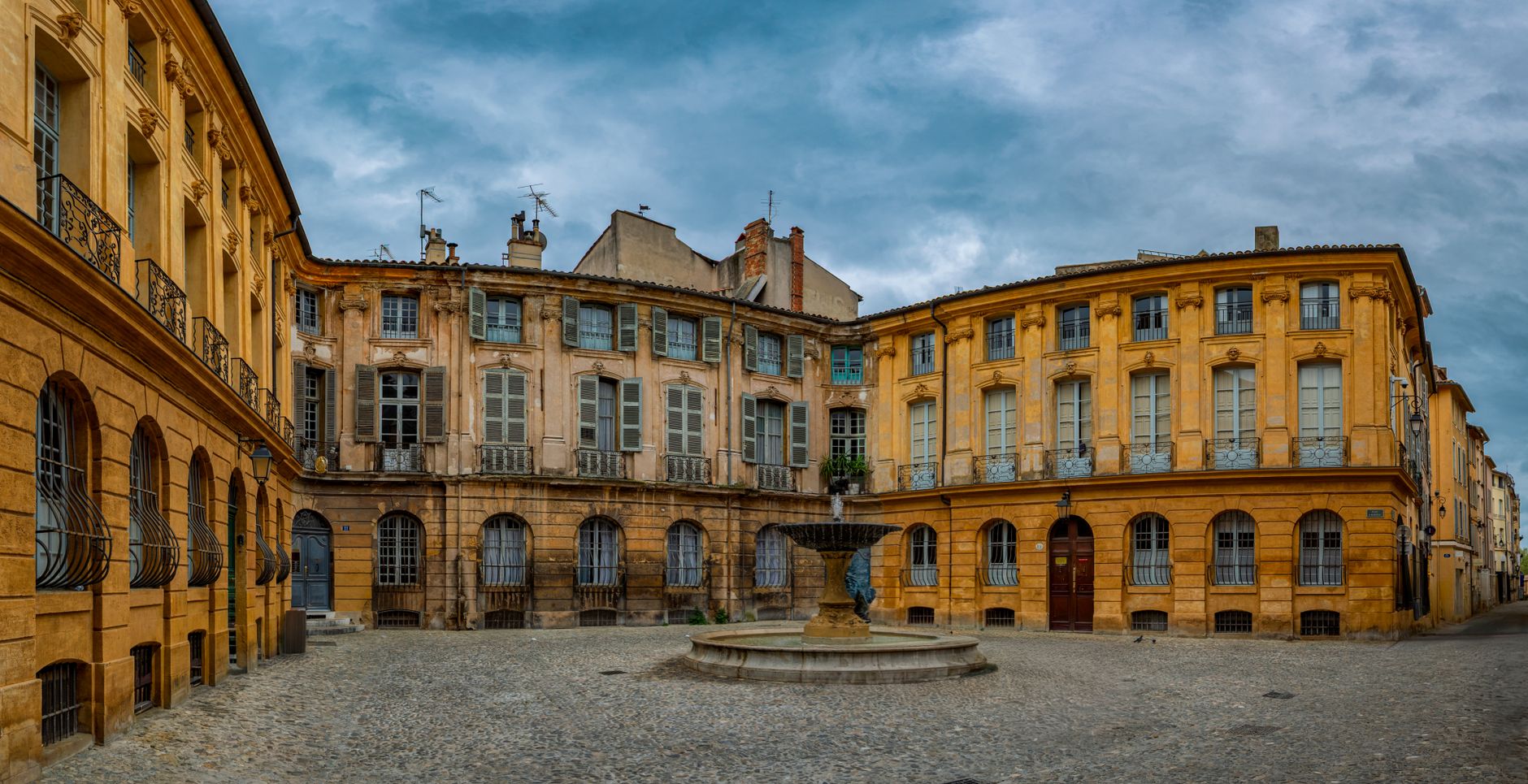

Water trickles through moss-grown stone fountains while plane trees filter a pale southern sun across the limestone paving. You walk everywhere here; the Roman-founded core belongs entirely to pedestrians and the morning rush for warm baguettes. Between the seventeenth-century mansions of the Mazarin district and the market stalls of Place Richelme, the town balances aristocratic poise with honest, market-driven lunch counters.
Last updated 27 Aug 2026
Build a Aix-en-Provence itinerary.
Choose up to 4 threads that pull you in. Your plan arrives organised around them.
We'll craft a 4-lens plan for Aix-en-Provence, one collapsible strand per lens.
Wine & Vineyards
Taste pale Coteaux d'Aix-en-Provence rosés and reds made from Grenache, Syrah, and Mourvèdre at cellar doors across the surrounding limestone hills.
Wine & Vineyards
Taste pale Coteaux d'Aix-en-Provence rosés and reds made from Grenache, Syrah, and Mourvèdre at cellar doors across the surrounding limestone hills.
Provençal Daube and Local Wine
Le Petit Verdot
Reserve a terrace table by phone. Expect to spend fifty euros per person for regional charcuterie, beef daube, and a bottle of local Grenache-Syrah blend.
Editor TipLocal winemakers in the Coteaux d'Aix-en-Provence appellation rely on limestone scree and mistral winds to produce robust, herbal reds that cut through slow-braised meats. Ask the server for an unfiltered Coteaux d'Aix red over the obvious chilled rosé; it pairs far better with braised beef.
Tasting Fresh Calissons
Confiserie Léonard Parli
Step inside this 1874 confectioner. Pick up a box of freshly glazed calissons and watch staff pack the diamond pastries by hand. Expect to spend twenty minutes and about ten euros.
Editor TipAix has protected the calisson recipe since the fifteenth century: sweet almonds ground with candied Cavaillon melon and orange peel, set on wafer paper and topped with royal icing. Ask for the calissons made that morning; the paste should yield softly, never crack like dry sugar.
Tasting Coteaux d'Aix Wines
Les Caves du Félibrige
Walk down Rue des Cordeliers into this vaulted cellar. Ask the caviste to pour a dry Coteaux d'Aix rosé and an earthy Palette red. Allow forty-five minutes; bottles start around twelve euros.
Editor TipLimestone soils and cooling Mistral winds shape the local Coteaux d'Aix and tiny Palette appellations, producing Grenache and Mourvèdre blends that avoid the flabby sweetness of mass-market pinks. Tell the caviste your dinner menu; they take quiet pride in pinpointing the exact vintage to match.
Historic Limestone Cellar Tasting
Château Simone
Book a tasting slot in advance by email. Spend forty-five minutes exploring the sixteenth-century vaulted cellars and sampling the estate's barrel-matured white wines.
Editor TipChâteau Simone anchors the tiny Palette appellation, where century-old Clairette and Grenache vines produce structured, age-worthy wines far removed from mass-market rosé. Ask to see the historic wooden presses in the lower vaults; the Rougier family has farmed this limestone slope since 1830.
Historic Architecture
Wander the Quartier Mazarin to inspect 17th-century hôtels particuliers, stone fountains, and the Romanesque cloister at Saint-Sauveur Cathedral.
Historic Architecture
Wander the Quartier Mazarin to inspect 17th-century hôtels particuliers, stone fountains, and the Romanesque cloister at Saint-Sauveur Cathedral.
Provencal Morning Market Tasting
Place Richelme
Wander the daily food market before 10:00 to buy melon, goat cheese from Banon, and almond calissons without queues. Entry is free; bring cash.
Editor TipPlanted with ancient plane trees, this daily square preserves the agrarian pulse of Provence, where local producers have sold seasonal harvest beneath Renaissance stone facades since the fourteenth century. Grab an espresso at the corner cafe simply to sit and watch the produce crates being unloaded.
Private Mansion Architecture Tour
Hôtel de Caumont Centre d'Art
Book your timed ticket online to explore this restored eighteenth-century mansion and its formal French gardens in the Mazarin district. Allow ninety minutes.
Editor TipBuilt between 1715 and 1742 for the local nobility, the residence represents the height of Provencal classical stone carving, wrought-iron balconies, and grand cour d'honneur architectural design. Walk via Rue Cardinale to admire the four-dolphin fountain before entering the courtyard.
Cistercian Cloister Walking
Abbaye de Silvacane
Buy your ticket at the entrance for nine euros. Spend an hour walking the quiet nave and vaulted chapter house before the morning tour groups arrive from Avignon.
Editor TipBuilt in the twelfth century along the Durance river, this limestone structure represents the austere, unadorned peak of Provençal Romanesque monastic architecture. Step into the warming room beneath the acoustic vaults; even a quiet whisper carries straight up to the ribbed ceiling.
Craft Traditions
Track down hand-painted clay santons crafted by master makers in old town workshops for traditional Provençal nativity displays.
Craft Traditions
Track down hand-painted clay santons crafted by master makers in old town workshops for traditional Provençal nativity displays.
Feasting On Provençal Daube
Restaurant Chez Thomé
Reserve an outdoor terrace table for dinner. Order the beef daube with buttered polenta and a bottle of local red, spending around fifty euros per person.
Editor TipSet in Le Tholonet below Sainte-Victoire, this former relay inn has fed painters and quarrymen local slow-cooked braises and olive-oil mash since the nineteenth century. Park in the lot behind the church and walk two minutes down the tree-lined lane to avoid the road traffic.
Note from the Editor
“Aix wakes up gently before nine, when the limestone still holds the morning cool and the market vendors are unpacking melons. By eleven the tour groups arrive at Cours Mirabeau, so move early.”
The Bed
Where to stay in Aix-en-Provence
Which part of town to book, and what each one costs you in walking, noise or quiet.
The Comparison
Aix-en-Provence, or somewhere near it
The places you are realistically choosing between, and the honest case for each.
The Local Record
Where to read more about Aix-en-Provence
The blogs, boards, guides and operators worth bookmarking.
What to do in Aix-en-Provence Provence France
Life here centres on the pedestrian grid, where mornings start with espresso on Cours Mirabeau and market shopping on Place des Cardeurs. The town moves at a civilized pace, trading coastal rush for afternoon gallery visits, museum courtyards, and long dinners over daube provençale. It suits travellers who prefer exploring on foot, architectural detail, and market-driven seasonal cooking over tick-box sightseeing.
24 hours in Aix-en-Provence Provence France
Start by 8:30 at Place Richelme for market produce, then walk the Mazarin quarter down to the Granet Museum. For lunch, order a bowl of pistou soup at a bistro off Rue Espariat. Spend the afternoon at Cézanne's studio uphill, returning to Cours Mirabeau before sunset for a glass of chilled rosé and an uncomplicated dinner of roasted lamb. Select 1 Day above to see it.
2 days in Aix-en-Provence Provence France
Dedicate the second morning to the Roman thermal springs or the cloister of Saint-Sauveur before taking a short bus east to Le Tholonet. Walk the lower paths facing Montagne Sainte-Victoire, then head into a country auberge for aioli with poached cod and crisp seasonal vegetables, far from the town centre crowds. Choose 2 Days to expand the plan.
3 days in Aix-en-Provence Provence France
A third day allows a vineyard loop through the Coteaux d'Aix plateau or a morning bus north to the hill villages of Lourmarin and Cucuron in the Luberon. Return in time for an evening calisson tasting along Rue Gaston de Saporta, followed by a quiet late-night digestif in the lantern-lit squares of the old quarter.
Aix-en-Provence Provence France itineraries by interest
Markets & Produce in Aix-en-Provence Provence France
Place Richelme fills daily with Cavaillon melons, Banon goat cheese wrapped in chestnut leaves, and sun-ripened tomatoes from local farms.
Historic Architecture in Aix-en-Provence Provence France
Wander the Quartier Mazarin to inspect 17th-century hôtels particuliers, stone fountains, and the Romanesque cloister at Saint-Sauveur Cathedral.
Local Sweets in Aix-en-Provence Provence France
Sample calissons d'Aix, the historic diamond-shaped paste of ground almonds and candied melon iced with royal sugar, baked since the 15th century.
Wine & Vineyards in Aix-en-Provence Provence France
Taste pale Coteaux d'Aix-en-Provence rosés and reds made from Grenache, Syrah, and Mourvèdre at cellar doors across the surrounding limestone hills.
Modern Art in Aix-en-Provence Provence France
Visit Atelier Cézanne on the Lauves hill, kept just as the painter left his still-life props, easel, and views toward Montagne Sainte-Victoire.
Fine Dining in Aix-en-Provence Provence France
Book dinner in discreet vaulted dining rooms where chefs pair Mediterranean red mullet and roasted lamb with tapenade and regional olive oils.
Day Trips in Aix-en-Provence Provence France
Take a 40-minute bus south to Marseille for bouillabaisse by the Old Port, or head east into the quiet, dry limestone ridges of the Luberon.
Hiking in Aix-en-Provence Provence France
Tackle the rocky trails of Montagne Sainte-Victoire, starting from Le Tholonet for red-earth panoramas across the arc of the Provençal valley.
Thermal Baths in Aix-en-Provence Provence France
Soak in the natural mineral waters of Thermes Sextius, built directly over the ancient thermal springs founded by Roman consul Sextius Calvinus.
Bookshops & Cafes in Aix-en-Provence Provence France
Settle with an espresso on Cours Mirabeau beneath the plane trees, or browse art catalogues in the historic courtyards of Rue d'Italie.
Sacred Art in Aix-en-Provence Provence France
View Nicolas Froment's 1476 triptych of the Burning Bush inside Saint-Sauveur Cathedral, open without ticket fees between parish services.
Craft Traditions in Aix-en-Provence Provence France
Track down hand-painted clay santons crafted by master makers in old town workshops for traditional Provençal nativity displays.