


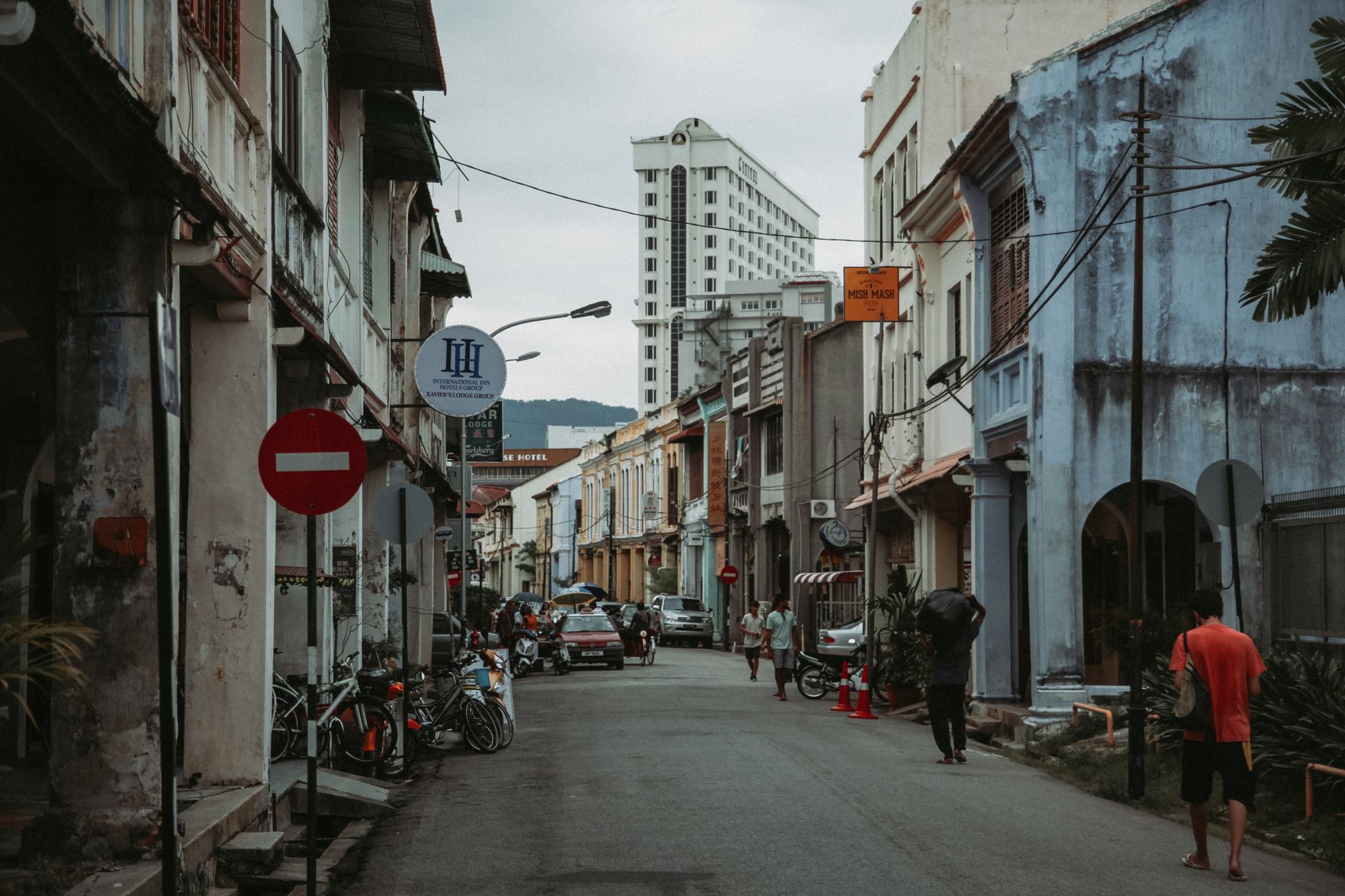


Morning begins under the five-foot ways with charcoal smoke, salted duck eggs, and the rhythmic clack of iron spatulas. George Town spreads flat across Penang Island's northeast point, its grid of British-era trading houses and Clan Jetties cooled by Malacca Strait breezes. You come here to eat char kway teow cooked over roaring cast iron and assam laksa redolent of torch ginger flower, walking off breakfast along Lebuh Chulia before the equatorial midday humidity settles over the stucco facades.
Last updated 22 Aug 2026
Build a George Town itinerary.
Choose up to 4 threads that pull you in. Your plan arrives organised around them.
The Bed
Where to stay in George Town
Which part of town to book, and what each one costs you in walking, noise or quiet.
The Comparison
George Town, or somewhere near it
The places you are realistically choosing between, and the honest case for each.
The Local Record
Where to read more about George Town
The blogs, boards, guides and operators worth bookmarking.
What to do in George Town Penang Malaysia
George Town revolves around the table. The walkable historic core is compact, structured around nineteenth-century shophouse arcades that protect you from sun and sudden tropical downpours. It suits independent walkers, architecture enthusiasts, and anyone who appreciates unvarnished culinary heritage where recipes pass intact across three generations of cooks.
24 hours in George Town Penang Malaysia
Start with kaya toast and soft eggs at Toh Soon Cafe on Lebuh Campbell. Spend the morning viewing shophouse facades and clan temples around Lebuh Armenian, break for assam laksa at Air Itam, and end the evening navigating the steam and clinking bowls of the Lebuh Chulia night hawker stalls. Select 1 Day above to see it.
2 days in George Town Penang Malaysia
Dedicate day two to Peranakan heritage with a morning tour of the Cheong Fatt Tze Blue Mansion, followed by a lunch of tamarind-braised pork belly and otak-otak. In the late afternoon, head out along the wooden boardwalks of Chew Jetty to watch fishing boats tie up before dusk. Choose 2 Days to expand the plan.
3 days in George Town Penang Malaysia
A third day allows an early ascent up Penang Hill on the funicular railway before tour buses arrive, followed by the sprawling hilltop pavilions of Kek Lok Si Temple. In the afternoon, escape the centre for the coastal fishing village of Teluk Bahang and a bowl of fresh crab noodles.
George Town Penang Malaysia itineraries by interest
Street Food in George Town Penang Malaysia
Wok hei rules the evening stalls along Lebuh Kimberley and Lorong Selamat, where high-heat lard fries duck egg char kway teow and pork-laden lor bak.
Sacred Architecture in George Town Penang Malaysia
Walk the Harmony Street corridor along Lebuh Masjid Kapitan Keling to see the 1801 Kapitan Keling Mosque, Sri Mahamariamman Temple, and Goddess of Mercy Temple.
Colonial History in George Town Penang Malaysia
Explore the star-shaped Fort Cornwallis built in 1786 and the neoclassical municipal offices along the Esplanade, where the British East India Company took root.
Clan Settlements in George Town Penang Malaysia
Chew Jetty and Tan Jetty extend into the harbour on stilts, built by nineteenth-century Chinese dockworkers who still maintain waterfront ancestral shrines.
Nyonya Cuisine in George Town Penang Malaysia
Peranakan cooking blends Chinese technique with Malay herbs, serving gulai tumis mackerel, pie tee shells, and nutmeg juice in preserved shophouse parlours.
Morning Markets in George Town Penang Malaysia
Chowrasta Market on Lebuh Tamil comes alive by seven with pickled nutmeg fruit, freshly rolled popiah skins, and steaming bowls of duck meat koay teow th'ng.
Urban Art in George Town Penang Malaysia
Ernest Zacharevic's wall murals and steel rod caricatures pepper Armenian Street and Muntri Street, best surveyed on foot before the afternoon heat peaks.
Historic Mansions in George Town Penang Malaysia
Tour the indigo-tinted 1880s Cheong Fatt Tze Blue Mansion and the gilded Pinang Peranakan Mansion to see Baba-Nyonya teak carvings and Scottish floor tiles.
Hillside Escapes in George Town Penang Malaysia
Ride the funicular railway up Penang Hill to 833 metres for breezy views across the strait and a walk through the nineteenth-century colonial hill station.
Temple Enclaves in George Town Penang Malaysia
Kek Lok Si Temple climbs the granite slopes of Air Itam, featuring a seven-tier pagoda, ten thousand bronze Buddhas, and steep stone stairways.
Tea & Coffee in George Town Penang Malaysia
Old kopitiams serve thick butter-roasted kopi o alongside charcoal-toasted Hainanese bread with runny eggs and coconut pandan kaya on Lebuh Campbell.
Craft Traditions in George Town Penang Malaysia
Traditional joss stick makers, songkok tailors, and hand-beaded Nyonya shoe cobblers still work quiet shopfronts along Lebuh Carnarvon and Lebuh Queen.